

Saving Millions by Perfecting a Single Layer: A Success Story with a Japanese Solar Giant

Moving Beyond “One-Size-Fits-All”: How Syntrix’s Tailored Precision Systems Rescued Production Yield.
This article demonstrates how a “tailored” equipment upgrade can resolve a crisis when traditional manufacturing hits a bottleneck. Instead of just delivering a machine, we go deep into the production line to tackle the root causes of material waste and high defect rates, ensuring every cent of a client’s investment translates into actual capacity growth.
Inside a manufacturing plant in Shizuoka, Japan, a technical manager named Mr. Sato was facing a nightmare. His solar cell production line was acting like a “leaking bucket.” Even though it was running at full speed, for every 100 cells produced, 20 ended up in the scrap bin.
“We aren’t just making cells; we’re burning money,” Mr. Sato sighed, pointing at the pile of rejected silicon wafers. The culprit was the coating process. The old equipment acted like a clumsy, heavy-handed painter—the conductive layers it applied were either too thick or too thin. If it was too thick, expensive silver paste was wasted; if it was too thin, electricity wouldn’t flow. This made the solar cells incredibly unreliable.
Last summer, the Syntrix team stepped in. We didn’t start with a sales pitch. Instead, we spent a full week on the factory floor. We noticed that even a slight change in factory temperature made the expensive coating liquids thinner or thicker. The old machines were too “rigid”—they couldn’t adjust to these fluctuations, leading to an uneven mess.
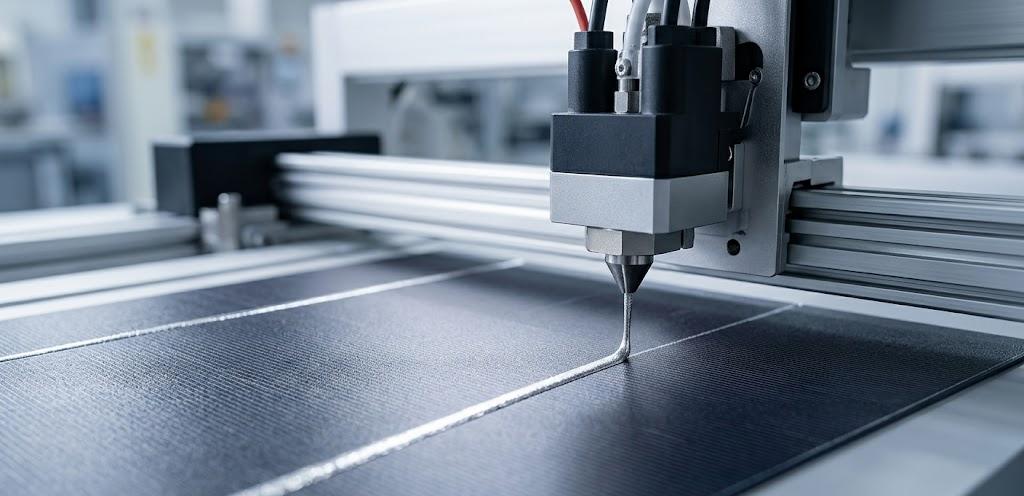
Once we found the “sickness,” we prescribed a “Smart” Precision Inkjet System tailored specifically for their needs.
What makes this system so smart? It acts like an experienced craftsman, automatically adjusting the spraying pressure and speed based on real-time changes in the environment. It doesn’t just spray; it “feels” the material.
The results were immediate: In the first month after installation, the once-bumpy coatings became as smooth as glass. To Mr. Sato’s delight, because the spraying was so precise and focused, the consumption of costly silver paste dropped by 15% immediately.
When the six-month report came out, the numbers told a powerful story: the production yield rate had climbed from 80% to a staggering 98%. This meant that the time and materials once wasted were now pure profit. This partnership proved to Mr. Sato that solving a big problem doesn’t always require a total overhaul—sometimes, you just need a solution that truly understands your process.